

Gen-Z Electoral Politics in South Asia: Divergent Youth Outcomes in Nepal and Bangladesh
5 May 2026
Overview
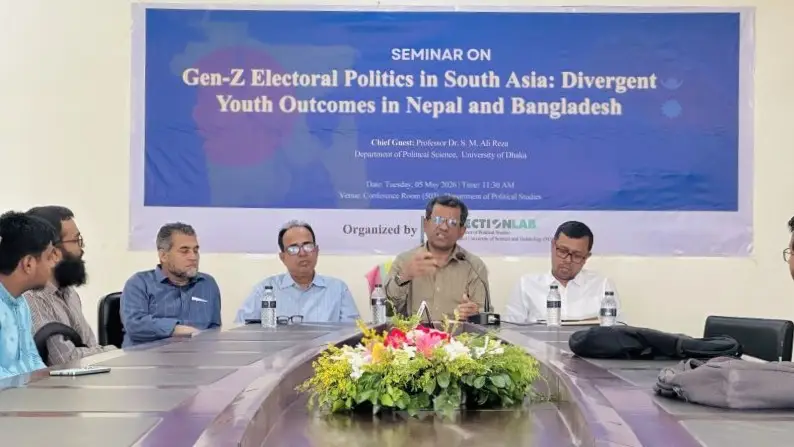
The Election Lab organized a seminar titled “Gen-Z Electoral Politics in South Asia: Divergent Youth Outcomes in Nepal and Bangladesh”, bringing together academics and researchers to examine the growing role of younger generations in political mobilisation and electoral politics. The seminar focused on the contrasting experiences of Gen-Z-led political mobilisation in Nepal and Bangladesh, exploring how differences in political objectives, organisational direction, public support, and subsequent political developments shaped their respective trajectories.
The seminar featured Prof. Dr. S. M. Ali Reza of the University of Dhaka as chief guest and was conducted by Prof. Dr. Md. Shahabul Haque, Director of the Election Lab. Prof. Dr. Md. Nazrul Islam and Associate Professor Dr. Md. Amdadul Haque also participated in the discussion, contributing perspectives on the political developments surrounding youth mobilisation and Bangladesh's evolving electoral landscape.
Comparative Perspectives on Gen-Z Mobilisation
A central theme of the seminar was the contrasting political experience of Gen-Z in Nepal and Bangladesh. In his remarks, Prof. Dr. S. M. Ali Reza drew attention to what he described as a clearer and more consistent set of political objectives among Gen-Z activists in Nepal. He contrasted this with the Bangladeshi experience, where the political direction and subsequent developments surrounding youth mobilisation were discussed as more contested.
Prof. Ali Reza also examined developments following 5 August and their broader political consequences. He linked the controversies surrounding subsequent leadership developments with growing public dissatisfaction and discussed how these developments influenced the political environment leading up to the 13th National Parliamentary Election.
The discussion therefore extended beyond youth participation itself to consider an important question in contemporary electoral politics: how does a youth-led movement translate political mobilisation into sustained political influence and electoral outcomes? The contrasting experiences of Nepal and Bangladesh provided a basis for examining this question within a broader South Asian context.
Political Developments in Bangladesh
Prof. Dr. Md. Nazrul Islam discussed the political environment surrounding Bangladesh's interim government and its priorities. He argued that the government had not established sufficiently clear priorities within the prevailing political circumstances and noted that the perceived political ambitions of some advisers had generated concerns among political parties.
He also raised questions regarding the strategic direction of the National Citizens Party (NCP), a political formation that emerged from the youth-led political mobilisation. His remarks drew attention to the challenges faced when a movement that begins primarily as a form of political mobilisation develops into an organised political actor.
Prof. Dr. Md. Shahabul Haque similarly reflected on the trajectory of the July student uprising. He argued that the movement subsequently lost some of its direction due to the influence of particular intellectual circles. In contrast, he described Nepal's Gen-Z mobilisation as having maintained a stronger focus, which, in his assessment, contributed to greater public support and political influence.
Event Significance
The seminar provided a comparative academic platform for examining the changing relationship between youth mobilisation, political organisation, and electoral politics in South Asia. Rather than treating Gen-Z political participation simply as a demographic phenomenon, the discussion considered how political objectives, organisational coherence, leadership developments, public support, and institutional conditions can shape the trajectory of youth-led movements.
By placing the experiences of Nepal and Bangladesh alongside one another, the seminar encouraged discussion of the different ways in which youth mobilisation can interact with established political institutions and electoral processes. The event also reflected the Election Lab's broader interest in understanding changing patterns of political participation and the evolving role of younger generations in electoral politics.