

Bangladesh & Makkah Pact: Prospects, Strategic Choices, and the Future of South Asia
8 September 2026
Overview
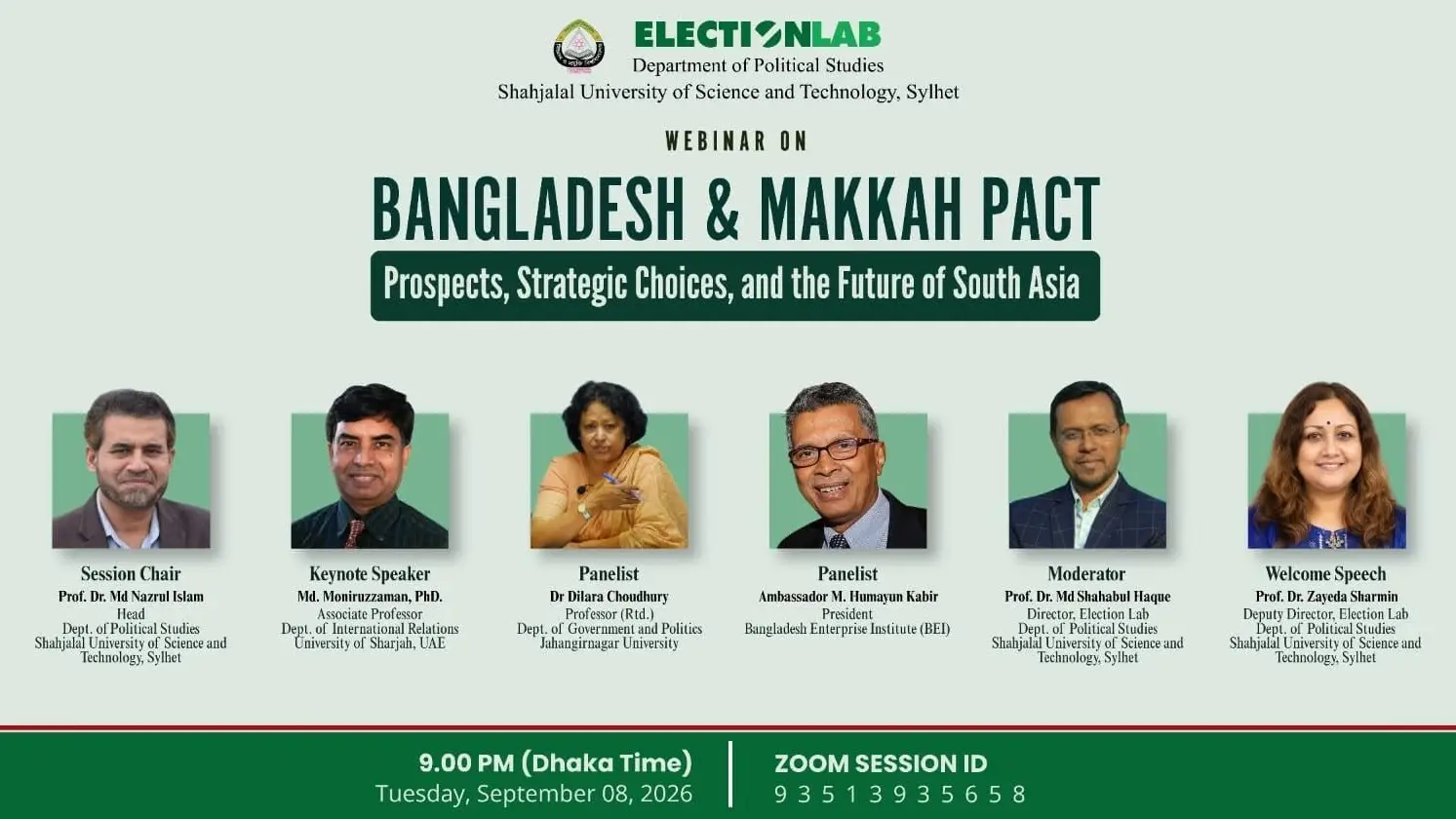
The Election Lab of the Department of Political Studies, Shahjalal University of Science and Technology (SUST), organized a webinar examining the proposed Bangladesh–Makkah Pact and its potential implications for Bangladesh and South Asia. The discussion brought together academics, diplomats, and experts to examine the strategic, economic, security, and foreign-policy dimensions of the proposed pact.The session was chaired by Prof. Dr. Md Nazrul Islam, Head of the Department of Political Studies, SUST, and moderated by Prof. Dr. Md Shahabub Haque, Director of the Election Lab. Prof. Dr. Zayeda Sharmin, Deputy Director of the Election Lab, delivered the welcome address. The keynote presentation was delivered by Dr. Md. Moniruzzaman, Associate Professor of International Relations at the University of Sharjah, while Dr. Dilara Chowdhury, Professor (Retd.) of the Department of Government and Politics at Jahangirnagar University, and Ambassador M. Humayun Kabir, President of the Bangladesh Enterprise Institute (BEI), participated as panelists.
Key Discussions
The discussion focused on the importance of assessing national interests, potential benefits and risks, regional security considerations, and Bangladesh's foreign-policy autonomy before making any decision concerning the proposed pact.Professor Dilara Chowdhury emphasized the need for a careful assessment of the potential gains and losses associated with the proposal. She noted that considerable media attention had surrounded the pact, while Bangladesh had not, at the time of the webinar, received a formal invitation and the full framework and policy details were not yet known. She therefore stressed the importance of further analysis before reaching a decision.Prof. Chowdhury also discussed the implications of military alliances and external partnerships, emphasizing the importance of maintaining Bangladesh's ability to pursue an independent and balanced foreign policy. She suggested that any potential decision should follow the receipt of a formal invitation and involve broader institutional and public consideration, including parliamentary discussion, consideration of public opinion, and an assessment of potential benefits, costs, and risks.Ambassador M. Humayun Kabir discussed the potential strategic significance of the proposed pact and its implications for Bangladesh's national interests. Dr. Md. Moniruzzaman examined the security concerns of Saudi Arabia, Pakistan, and Turkey and discussed the possible regional implications of greater cooperation among these countries.
Event Significance
The webinar provided a platform for examining the proposed Bangladesh–Makkah Pact from multiple academic, diplomatic, and strategic perspectives. Discussions addressed questions of national interest, regional security, foreign-policy autonomy, and the potential implications of emerging strategic partnerships for Bangladesh and South Asia.This format is better for the website because the people are introduced naturally as part of the event narrative, rather than making the page look like a conference programme. It also keeps the emphasis on what the event discussed, which is what a visitor to the Events section is most likely to want to know.